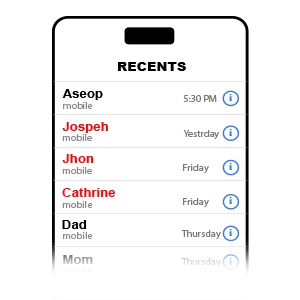

Available chat context
Review supported message details around a contact or conversation that raised concern.
WhatsApp can carry family plans, school groups, close friendships, voice notes, calls, and messages from people a child barely knows. FonSee helps parents review available WhatsApp activity from a supported family phone when a real concern needs context.
Use FonSee only on an authorized phone, with required notice and consent. Support varies by phone, setup, and plan.


Review supported message details around a contact or conversation that raised concern.

See available call or audio context when those details are supported by the phone setup.

Notice available links, photos, or other shared content tied to the conversation.
FonSee WhatsApp parental control can show available WhatsApp chats, contacts, call details, and shared items from a supported, authorized family phone. Coverage varies and should not be assumed complete.
A new number, late-night group chat, repeated call, or request for secrecy can leave a parent unsure how to begin. Reviewing the small part of the conversation connected to that concern may show whether the issue is normal peer friction, a scam, harassment, or an unsafe adult contact. The goal is to reach the right conversation sooner. A child may need help blocking a contact, leaving a group, saving evidence, or simply finding words for an uncomfortable exchange.
End-to-end encryption, disappearing messages, deleted content, app updates, phone settings, and connection timing can affect what appears. Missing activity is not proof that a child hid something. A chat excerpt cannot carry a whole friendship, joke, disagreement, or change in tone. Ask your child what happened before deciding what the words mean.
The sample view keeps whatsapp activity, the selected family phone, and the available time or source details together. Start with the item tied to your question. Check its label and surrounding context instead of opening a wider history without a reason.
A message may be quoted, forwarded, edited, sarcastic, or separated from earlier context. Voice notes can also be hard to interpret without knowing the relationship and situation.
A defined reason keeps the review focused and easier to explain. These examples show how the feature can support a conversation without turning ordinary phone use into a constant investigation.
Review the available contact and call pattern, then ask whether the person requested money, private images, account codes, secrecy, or an in-person meeting.

Look at the surrounding messages when teasing turns into exclusion, threats, or a pile-on. Help your child mute, leave, report, or involve a trusted school adult.
Check the sender and nearby message before anyone opens it. Talk through fake delivery notices, copied sign-in pages, urgent payment requests, and requests for verification codes.
App coverage changes as services update encryption, disappearing messages, account types, and phone permissions. Check the current support details for the exact app and device.
Check device compatibilityConfirm the exact phone, operating system, setup method, permissions, connection needs, and FonSee plan before you depend on the feature.
Explain which concern may lead to a review, who can open the dashboard, and which ordinary conversations will stay private.
Open the smallest useful part of whatsapp activity, check the available source and time, and use it to understand the exchange and choose a helpful response. Close the dashboard when the question is answered.
Messages often include friends and classmates who did not choose your family plan. Keep their information private and share it only when safety or lawful reporting requires it.
Connect only a phone you own or are allowed to manage. Follow the notice, consent, privacy, and recording rules that apply where you live.
Friends, relatives, teachers, and classmates may appear in the same thread. Keep their words private and share only what a safety response or lawful report needs.
Use a strong password, limit account access, sign out on shared computers, and keep sensitive phone information out of group chats and social posts.
Parents need useful context and a clear next step, not more data for its own sake.
“The group messages showed that my son was being pressured to share an account code. We secured the account and practiced how to leave the chat without blaming him for answering at first.”
Check the practical details before connecting a family phone.
Depending on support, it may show available chats, contact details, timestamps, calls, voice notes, or shared items from the connected family phone.
Do not assume complete access. Encryption, disappearing messages, deleted data, app protections, permissions, and connection timing can limit available activity.
Some call or audio details may be available on supported setups. Check current compatibility for the exact phone and FonSee plan.
Ask your child what happened, block or report the contact when appropriate, secure affected accounts, and involve a trusted service or authority if the risk is serious.
No. Support varies by phone, operating system, setup, permissions, connection, and plan.
Yes. Use it only on an authorized phone and follow applicable notice, consent, and privacy rules.
Check that the phone is online, connected, supported, and allowed to provide the feature.
No. Phone data gives limited context. Ask what happened before reaching a conclusion.
Check phone and app support, agree on privacy limits, and choose a plan that fits the concern you are trying to understand.